- Aerospace, Naval & Defence, Risk Management
In large-scale programmes, effective risk management plays a critical role in proactively identifying vulnerabilities that could compromise delivery. In this complex software migration project, however, a lack of standardisation, visibility and coordination across teams was limiting the organisation’s ability to detect emerging risks early and support informed decision‑making. The aim of this transformation project was, therefore, to evolve from a reactive and fragmented approach towards a more structured and data‑driven risk management model.
In this context, MIGSO-PCUBED collaborated with a client in the aerospace sector on a critical digital transformation project, focused on migration to a new software platform. In an environment with multiple stakeholders and high operational complexity, the organisation needed to strengthen its risk management to improve project stability and the reliability of decision-making throughout its lifecycle.
Context
Our client was facing a complex software migration project, and with it a crucial challenge: the management of risks and opportunities associated with this migration. In the absence of an adequate structure and a lack of visibility, the project was exposed to delays, unforeseen cost increases and unnecessary complications that could easily have been addressed through proper risk and opportunity management. Risk monitoring within the organisation was fairly basic, which hindered planning and the adoption of effective mitigation measures, and jeopardised the success of the entire operation.
Given this situation, it became essential to consolidate the risk management process through a clear and optimised methodology, supported by a specific risk and opportunity management tool.
A system in need of structure
The client’s objective was to improve the project’s risk management to ensure more agile and reliable decision-making. An initial analysis revealed that risks were managed independently, without a standardised approach or an integrated tool to facilitate their monitoring. This lack of structure led to discrepancies, hampered coordination between teams and delayed critical decisions, increasing the project’s uncertainty.
Such challenges are common in complex environments with multiple stakeholders, where the absence of a common methodology limits operational efficiency. To address this situation, we defined a new strategy based on process standardisation and the use of a risk management tool as a central pillar.
A comprehensive shift towards robust risk management
To address the lack of alignment and control in risk management, a comprehensive solution based on three key pillars was implemented.
Firstly, collaborative sessions enabled key teams to align around a common understanding of risks, reducing discrepancies and eliminating differing interpretations that were slowing down decision-making. As a result, the project gained agility and consistency at critical junctures.
In parallel, the combination of top-down and bottom-up approaches ensured comprehensive risk identification, integrating both strategic and operational perspectives. This enabled the anticipation of critical risks that had previously gone unnoticed, improved their prioritisation, and strengthened the team’s ability to respond to potential deviations.
Finally, the implementation of a common management tool provided a centralised, real-time view of the project’s risks and opportunities. This not only improved monitoring but also enabled faster, more consistent decisions based on reliable data.
Overall, the solution transformed risk management into a structured, collaborative and action-oriented process, giving the client back control over the project and reducing uncertainty in decision-making.
Want to know more about the Risk Management process?
Explore the four steps of the Risk Management Process, including how to identify and assess potential project-related risks and opportunities, as well as how to respond to them efficiently.
A structured methodology for progress
To structure and accelerate improvements in risk management, a maturity model was defined to objectively assess the project’s current level and establish a clear roadmap for development. The initial assessment placed the project at a maturity level of 1.5, highlighting the existence of isolated and unstructured practices that limited the effectiveness and consistency of risk management.
Based on this assessment, a progressive action plan was rolled out, centred on the implementation of specific tools and the adoption of best practices in risk identification, assessment and mitigation.
As a result, over a two-year period the project saw a significant leap in its maturity level, rising from 1.5 to 4. This development involved the consolidation of structured processes, the integration of risk management into decision-making, and a greater ability to anticipate potential deviations, transforming reactive management into a proactive, data-driven approach.
Beyond methodological improvement, this progress led to greater control over the project, reducing delays in key milestones, improving the reliability of planning and enabling more agile and consistent decision-making, thereby laying the foundations for an organisational culture focused on proactive risk management.
The key elements used in this process were:
- Waterfall charts: These provided a clear overview of the progress made on the proposed risk mitigation measures and enabled the impact of those measures to be quantified.
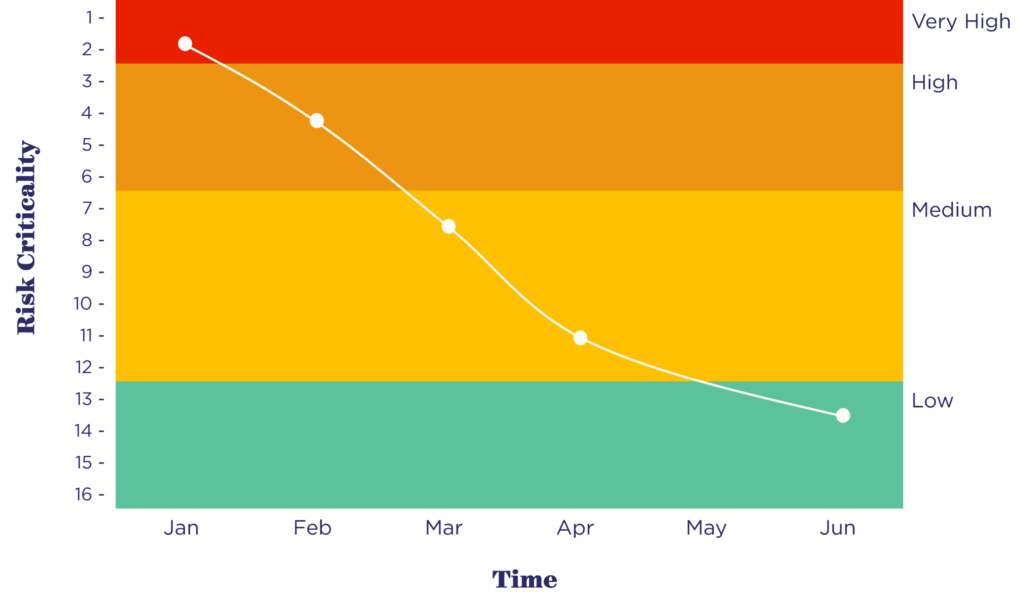
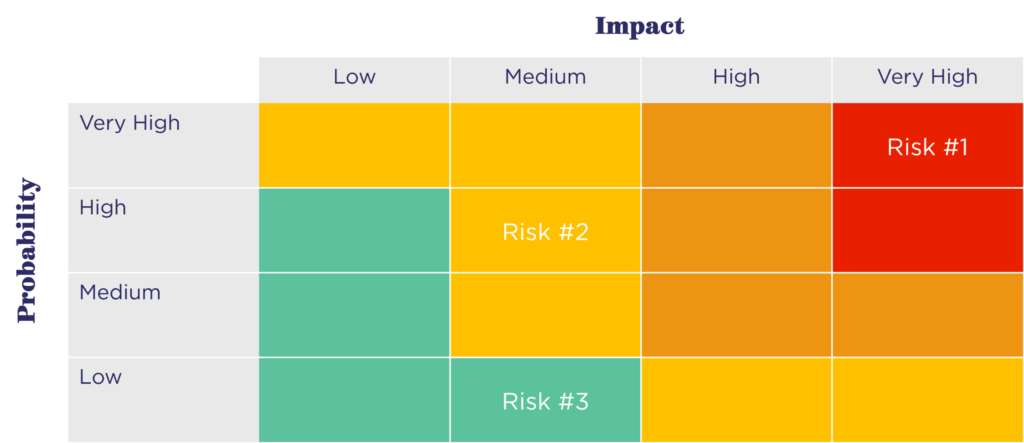
- Criticality matrix: This enabled us to map the criticality of the project’s most significant risks, as well as their evolution at each review.
- Regular follow-up meetings: These sessions were essential for assessing the status of risks, adjusting strategies and ensuring consistent progress.
- Key Performance Indicators (KPIs): Specific metrics enabled us to monitor the effectiveness of the improvements implemented, ensuring sustainable progress.
Read also
Learn more about these and others key elements of Risk Management.
A tangible and sustainable change
The transformation had a direct and measurable impact on project performance. Risk management efficiency increased by 62%, exceeding initial expectations and enabling more agile and effective management.
The mitigation measures implemented significantly reduced critical risks, minimising their impact on the project and eliminating them entirely in several cases. This resulted in greater stability in execution and a reduction in potential deviations from key milestones.
The implementation of a single risk management tool improved coordination between teams and provided a shared, real-time view of risks, facilitating truly proactive, data-driven management.
Beyond the immediate results, this transformation not only ensured the successful execution of the migration project but also strengthened the client’s ability to anticipate and manage uncertainty in future projects, improving the reliability of their planning and their capacity to respond to new challenges.
62% more efficient
Risk management now outperforms initial expectations, driving agility and effectiveness to new heights.
Conclusion
This case study demonstrates how the adoption of a structured methodology, combined with the right tools, can transform a critical area such as risk management. This approach not only resolved a specific problem but proved to be the cornerstone of change for the client, contributing directly to the success of other strategic projects and laying the foundations for continuous and sustainable growth.
Thank you to the Spanish Risk Management CoP of MP for contributing to this article.
Key results
- 62% increase in risk management efficiency
- Maturity level increased from 1.5 to 4 in 2 years
- More agile, consistent and data-driven decision-making
- Establishment of a proactive risk management culture, improving anticipation and reducing project uncertainty