- Aerospace, Naval & Defence, Digital PMO
One of our clients in the Netherlands, a global naval industrial group, set out to improve their PMO’s maturity. However, they faced uncertainty on how to leverage AI tools for greater PMO capability and how to incorporate them into a PMO improvement roadmap with clearly defined actions.
The MIGSO-PCUBED (MP) team applied our custom AI PMO Maturity framework, which has proved highly successful across different organisations and is a pillar for our PMO assessments today. In just 10 months, the client’s PMO gained a clear roadmap with embedded AI practices and saw measurable improvements.
Digital PMO mapping and PMO practices improvement with AI tools
Facing imbalanced maturity across key PMO functions (particularly in Scheduling, Cost, Scope, Risk, and Reporting), the client required a clear and structured path to modernise their ways of working. They also needed a better understanding of their current processes and tools to identify where AI could be beneficial. To address this, MP introduced a two‑phased approach designed to diagnose the most critical barriers and then implement targeted improvements.
Phase 1: The AI PMO Assessment
While a traditional PMO Assessment is an exercise that has been done for years, most do not reveal AI readiness, nor do they produce a pragmatic adoption path. MIGSO-PCUBED has developed an advanced framework that our consultants utilise not only to evaluate AI-integrated PMO maturity, but also to create a transformation roadmap for AI adoption.
First, the MP team conducted an in‑depth review of the client’s existing digital practices within the PMO. Since this client managed many different complex programmes, their PMO team comprised of over a hundred members, making a complete evaluation challenging for them to perform in-house.
MP analysed how work was organised, how information flowed across teams, and the extent to which digital tools supported day‑to‑day delivery. The assessment also examined where current processes created inefficiencies and where AI‑enabled capabilities could most effectively accelerate performance. In this way, the team was able to pinpoint both immediate quick wins for AI adoption and longer‑term opportunities to modernise their operating model.
As a result of these surveys, the MP team discovered:
- 85% of the PMO don’t utilise an AI solution because they don’t know how to start
- 90% of the PMO see the opportunity of AI to improve their efficiency on Risk Management
These findings are not unique to this client, and our AI PMO assessments reveal similar statistics for clients of ours around the world. Most see potential for AI to improve their efficiency but don’t know how to implement it.
Check it out
Get a taste for your AI readiness with our free online evaluation tool! You’ll get instant recommendations on how to improve your PMO and prepare for the future.
Understanding the PMO Vision
After identifying long‑standing challenges with fragmented data, inconsistent reporting flows, and differing expectations across a large PMO, MP worked collaboratively with the client to clarify their future digital vision. Through alignment workshops with PMO leaders and teams, MP helped surface where information was dispersed, how tools were being utilised, and what constraints were limiting digital maturity.
This process enabled the organisation to identify a unified “single source of truth” for PMO data and to define a clear 1-to-5-year strategic direction for evolving processes, tools, and skills. The result was a shared and actionable vision for the Digital PMO, grounded in organisational priorities, supported by strong governance, and designed to scale AI‑enabled capabilities effectively and sustainably.
The AI PMO Maturity framework by MP
Using our proprietary maturity framework and backed by a team of project controls experts, MP able to enhance PMO efficiency with an AI solution that integrates into the client’s existing IT toolbox. In this case, our client preferred using an AI tool from the Microsoft suite: Copilot.
Whether it be Copilot from Microsoft, Gemini from Google, or even Clay from our very own Clayverest, we at MP work with each of our clients to determine the tool that works best for them.
MP’s AI PMO Maturity framework is be grounded in practical, hands‑on PMO experience, particularly within complex engineering and industrial environments. The framework defines four levels of AI‑enabled PMO maturity, each representing a significant step forward in digital capability.

In the case of our Dutch client, this framework allowed MP to benchmark current performance, identify gaps, and create a tailored roadmap that aligned both with their strategic objectives and their appetite for AI‑enabled change.
Phase 2: The AI PMO Transformation
Following completion of the assessment, the MP team moved into the transformation phase, focusing on implementing the digital roadmap and deploying AI tools as part of the PMO’s daily operations.
Empowering the team with improved ways of working
To fully realise the benefits of AI within daily PMO operations, the client needed more than access to new tools. They required confidence in addition to clear processes that made AI genuinely useful. MP addressed this by equipping the PMO with the capabilities and structures needed to integrate Copilot effectively into their environment. This included strengthening digital literacy, aligning AI utilisation to high‑value PMO activities, and ensuring that Copilot could support core functions such as risk analysis, scheduling, and governance reviews.
With this new solution in place, the MP team also redesigned several PMO processes to take advantage of AI‑enabled efficiencies. This included:
- Enhanced risk analysis, providing faster risk identification, trend detection, and clearer mitigation insight.
- Stage and gate analysis, streamlined with automated documentation reviews and status assessment.
- Scheduling scenario analysis, supported by automated interpretation of schedule data and accelerated what‑if scenario evaluation.
This automation allowed the PMO to move away from time‑consuming data consolidation and toward higher‑value analytical work, improving both the speed and quality of decision‑support across the organisation.
Impact Delivered
The transformation generated measurable and meaningful benefits for the client’s PMO:
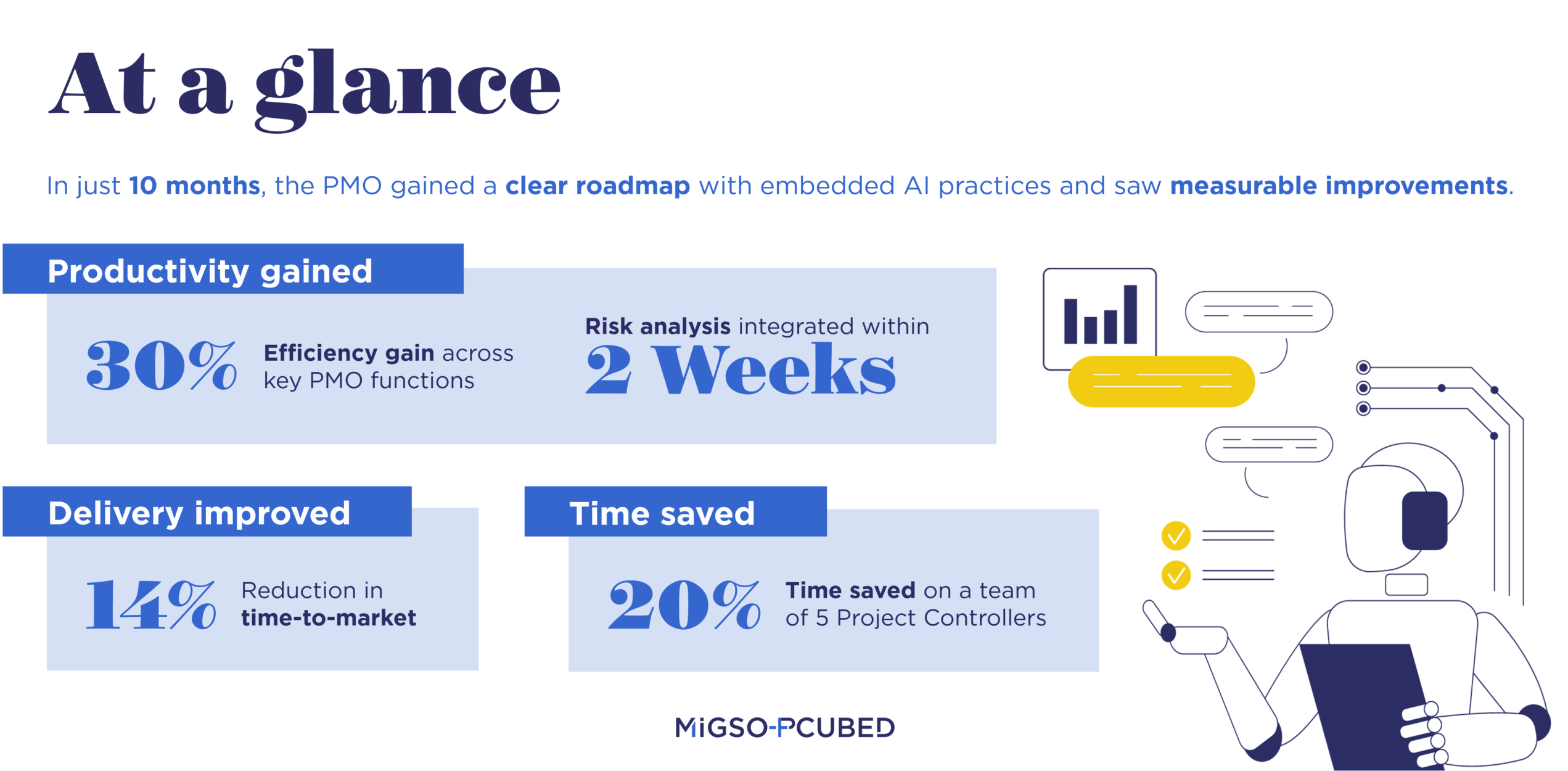
- Time saved: 20% saved on a team of five Project Controllers
- Risk analysis integrated into PMO activities and reduced to within 2 weeks
- Efficiency gain: +30% across key PMO functions
- Time-to-market reduction: 14%
These results demonstrate the success made possible by combining PMO expertise with AI‑enabled tooling in a well-structured framework. For complex engineering organisations like this client, MP demonstrated how modern PMOs can significantly elevate performance, decision‑making, and delivery outcomes through AI.
Thank you, Agathe Vignolle, for contributing to this article.
Key results
In just 10 months, the client’s PMO gained a clear roadmap with embedded AI practices and saw measurable improvements.
- 30% efficiency gain across key PMO functions
- 14% reduced time-to-market
- 20% time saved on a team of five Project Controllers
- Risk analysis integrated into PMO activities and reduced to within 2 weeks