- MP
- Blog
- Portfolio Management
- From Damage Control to Focus: How PMOs Prioritize the Pipeline
In industrial organizations, project teams often operate in a perpetual state of urgency. For example:
- A customer requests an accelerated product modification to meet a new demand.
- A new regulatory compliance programme has a fixed deadline and critical market impact.
- New orders are exceeding production capacity implying project parallelization and prioritisation
This sense of urgency is a symptom of portfolio missing control.
When leadership lacks a mechanism to align demand with capacity, PMOs end up managing the consequences rather than enabling strategic choices. The solution isn’t better project execution; it’s better portfolio control.
Problem solving starts before execution
When delivery pressure increases, organisations often look for solutions within individual projects. Although this can create some value, it rarely solves the underlying issue if the organisation struggles to prioritise projects at the portfolio level.
Example
We recently encountered this challenge at an internationally operating industrial client. New initiatives were entering the organisation from multiple directions: product updates, operational improvements, regulatory requirements, and corporate programmes. None of them could easily be rejected as they all brought value. The challenge was determining how a limited population of project managers could support such a broad pipeline of work. The discussion quickly moved away from project management practices and towards a more fundamental question: which projects should move forward, which could be consolidated, and which should wait.
Most organisations have mature mechanisms for approving projects. Far fewer have equally mature mechanisms for deciding which initiatives should be delayed, reshaped or challenged when resource capacity becomes constrained.
Visibility is not analysis
Many organizations assume that better visibility (such as more dashboards, detailed reports, or AI-driven insights) will automatically improve prioritization. However, visibility and decision-making are fundamentally different.
Examples:
During our PMO assessment for a medical devices client, we discovered that project data was available, but only 30% of leaders trusted it to guide trade-offs. While the PMO spent 40% of its effort maintaining reports, it lacked the mandate to challenge misaligned initiatives or expose resource conflicts early.
Additionally, we saw with one of our manufacturing clients that most dashboards were barely used, with only 11% of users accessing their internal Project Management reports.
In both examples, the real issue wasn’t a lack of information; it was the absence of a decision-making framework to act on it. Despite having good project data and streamlined reporting, without clear criteria for prioritization, even the perfect report leads to the same outcome: more information, less action.
Many organisations find themselves in this paradoxical situation. They spend considerable effort collecting data, invest in dashboards, and generate increasingly detailed reports yet leadership conversations continue to focus on validating information rather than making decisions, which the data should enable.
Therefore, the challenge is not generating more information; it is converting it into decisions to effectively manage the portfolio and prevent continuously shifting priorities.
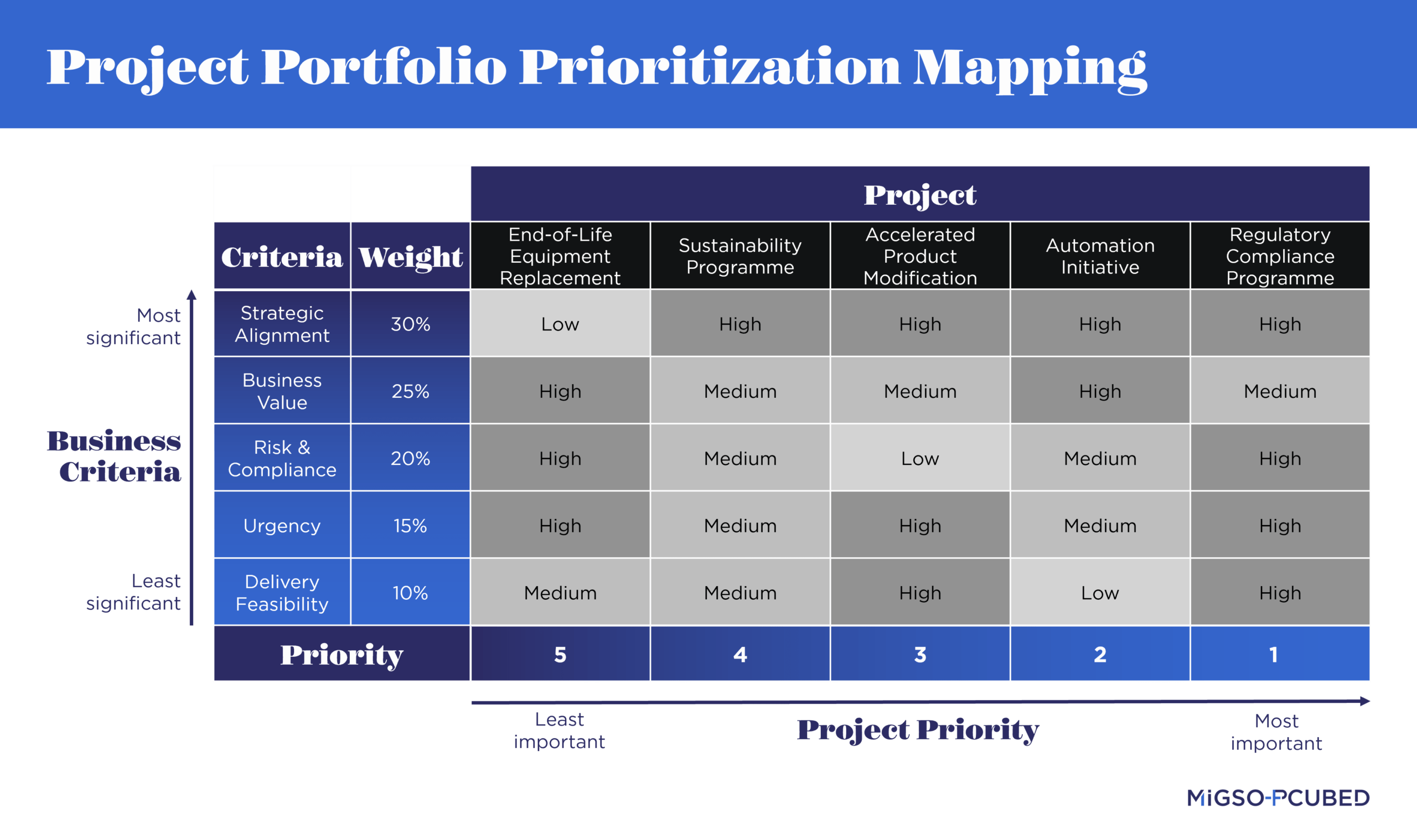
The consequences of avoiding trade-offs
Persistent project urgency is often the visible symptom of ineffective portfolio decisions. When priorities are unclear and resources are spread across too many initiatives, project teams experience the consequences through delays, resource conflicts, and constant reprioritisation. The PMO's role is not simply to report on these issues, but to provide the insight needed for better decisions.
Examples:
An engineering consultancy client provided a good illustration of this dynamic. Resources were continuously moved between projects to resolve immediate issues, creating temporary improvements in one area while generating new pressure elsewhere. Each intervention appeared logical in isolation, yet the overall effect was a growing cycle of resource conflicts and delivery instability. Over time, the organisation spent more effort managing portfolio conflicts than addressing their root causes.
A similar pattern emerged at a client in the defence industry. Large programmes regularly absorbed scarce technical expertise before existing commitments had been completed. Resource conflicts were visible and regularly discussed, yet difficult trade-offs were often avoided. Maintaining commitments proved easier than reassessing them, even when the impact on other projects was becoming increasingly apparent.
In both cases, project managers inherited the consequences of portfolio decisions that had never been fully resolved. This is how an organization becomes mainly reactive to operational issues. By translating information into prioritisation choices, PMOs enable portfolio optimisation and create the conditions for more predictable delivery.
How a PMO can prevent damage control
The PMO is not responsible for deciding which projects proceed and which do not. Those remain business decisions. But by providing a portfolio-wide perspective, the PMO enables leaders to make more informed prioritisation decisions and focus resources where they deliver the greatest value. Reducing unexpected changes, pressure, and delivery problems.
Returning to our example of the industrial clients, both in Defence and in Engineering, we see this play out. For them, the focus was understanding how project demand could be aligned with limited PM capacity. It meant exposing the wider impact of resource decisions that initially appeared local.
The objective remains the same: moving discussions away from individual project interests and towards a broader understanding of portfolio trade-offs.
Five tips to focus your portfolio
A focused portfolio is not the result of better reporting, but rather the result of better decision-making. These five disciplines help translate strategy into a realistic and achievable portfolio.

1. Establish a single view of incoming demand
Have one central overview of all proposed and active initiatives so that decisions are made based on the full picture rather than individual requests.

2. Distinguish between mandatory, strategic and discretionary work
Not every initiative should compete on the same criteria.

3. Connect prioritisation to actual delivery capacity
If every project assumes access to the same scarce expertise, the portfolio is not a plan but a wish list.

4. Establish a regular decision rhythm
Prioritisation is not an annual exercise, because markets shift, constraints emerge and new opportunities appear continuously.

5. Make stopping projects acceptable
Very few companies have mature mechanisms for pausing, reshaping or stopping initiatives when circumstances change.
1. Establish a single view of incoming demand
Have one central overview of all proposed and active initiatives so that decisions are made based on the full picture rather than individual requests.
2. Distinguish between mandatory, strategic and discretionary work
Not every initiative should compete on the same criteria.
3. Connect prioritisation to actual delivery capacity
If every project assumes access to the same scarce expertise, the portfolio is not a plan but a wish list.
4. Establish a regular decision rhythm
Prioritisation is not an annual exercise, because markets shift, constraints emerge and new opportunities appear continuously.
5. Make stopping projects acceptable
Very few companies have mature mechanisms for pausing, reshaping or stopping initiatives when circumstances change.
A simple self-assessment
Ask yourself; if a new strategic priority landed on your desk tomorrow, would your organisation know exactly what to stop, pause or postpone?
If the answer is no, strategic priorities are likely competing without a clear mechanism to make and sustain portfolio choices.
This is where PMOs create their greatest value. Not through more reporting, more governance or more process, but by helping leadership understand the consequences of competing choices and acting on them early by institutionalizing the five disciplines above. AI will continue to make information more easily accessible and portfolio visibility more powerful than ever before. However, visibility alone is not going to create value.
In that sense, the role of the PMO is not simply to improve project delivery. It is to help the organisation make better decisions and ultimately, convert limited capacity into maximum business value.
Thank you to Matthijs VAN DER VELDEN, Arnaud BEAUTRU-FRAIN, and Martijn DE WITTE for contributing to this article.