- Automotive & Transportation, Project Dashboards
Context
Within the process-engineering department of a key player in the automotive manufacturing industry, MIGSO-PCUBED was engaged to support the digital transformation of their process for monitoring expected project milestones. Previously, this process was done on Excel documents with VBA macros. However, the single user’s side as well as the significant maintenance were obstacles to monitoring their milestones efficiently.
With the evolution of Microsoft 365 and the disappearance of shared networks, it was decided to turn to new technologies. Thus, after careful analysis, the decision was made to switch to a Power Apps application with a SharePoint database. In addition, given the capabilities of Microsoft's application, new possibilities such as multi-project indicators could be considered for both macro and micro monitoring.
Change management
Key change management players
Ambassadors play a key role in leading the change of a digital transformation project. On one hand, they make it possible to instill a dynamic towards change as well as to facilitate the employees’ acceptance of the new tool.
In this case, our client was the main ambassador as well as a part of the employees who were open to change and interested in new digital opportunities.
Nevertheless, at MIGSO-PCUBED, the Digital Operations team plays a critical role in a digital transformation project such as this. This team is made up of digital PMO consultants who:
- Carry out a qualification of needs in order to better understand the client's digital challenges and/or needs, even before starting their engagement. It is also during this stage that technical opportunities are addressed.
- Are able to guide the client throughout the mission towards the best solution in order to design the most ergonomic and sustainable tools. They are also there to reassure and alert the client about any risks and to find alternatives if necessary. Thus, they are the facilitators of change.
Depending on a client's environment and sensitivity of their data, their opportunities are not the same. In this client's company, the arrival of Microsoft 365 has made it possible to offer solutions such as SharePoint, Power Apps and Power Automate that were previously untapped. These solutions are complementary and not only allow data to be collected, processed, and analyzed respectively but also to automate certain tasks.
In some cases of digital transformation, change can challenge the entire organization or processes and, therefore, requires a community of experts on change management to intervene.
How do you convince users?
The best way to convince users is, of course, with convincing results!
In our case, the results were edifying because a significant reduction in the workload of project managers was observed, allowing them to focus more on value-adding tasks.
These time savings were thanks to the grouping of multiple tools into a single one, as well as the reduction in data re-entry and maintenance times. In addition, the new tool now updates performance indicators in real-time.
As with any transformation, however, there are people who resist change. Those who do will find many reasons to discredit the new tool and not use it. As a result, they require special attention.
Some employees do not want to use the tool because they fear not being able to master it. For this type of user, training and occasional support generally help to unblock the situation. Others were already not using the previous tool. For this type of user, regular support is essential to demonstrate the interest of the tool and thus convince them in the long term.
Deploying the new solution
Convincing results
This digital transformation has generated many significant results, testifying to a significant improvement in the efficiency and productivity of processes and deliverables. Digitalization has been shown to save a lot of time in project management by consolidating all the necessary information into one tool, facilitating faster and more informed decision-making as well as eliminating the need to re-enter information.
At the same time, this transformation has enabled feedback that did not exist until then and the creation of new management KPIs based on it. This approach has also led to a standardization of working methods, reducing variations and errors (no more local copies of standards that may not be up to date).
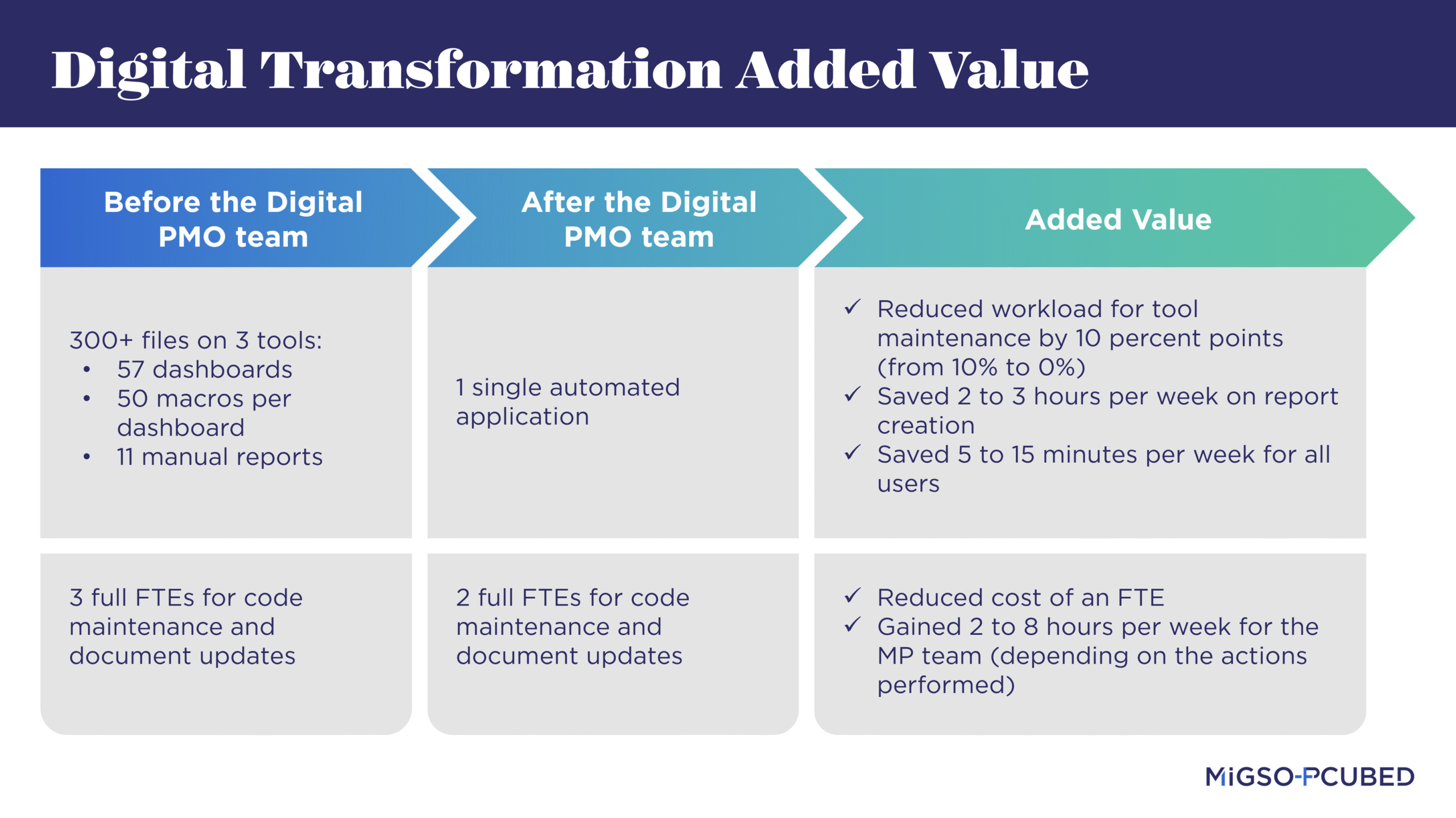
Another striking result of this transformation is the reduction in maintenance time of their reporting tools. Thanks to the new tools used, the workload allocated to maintenance has been reduced from 10% to 0%, so the team can now focus on new developments and continuous improvement.
Finally, one of the most impressive achievements was the consolidation of more than 300 files across 3 different reporting tools into a single application, simplifying data management, improving the user experience, and making it autonomous on many topics that otherwise required the intervention of the MIGSO-PCUBED teams.
These results illustrate how digital transformation has become a strategic lever for this automotive company, driving innovation and agility within the company.
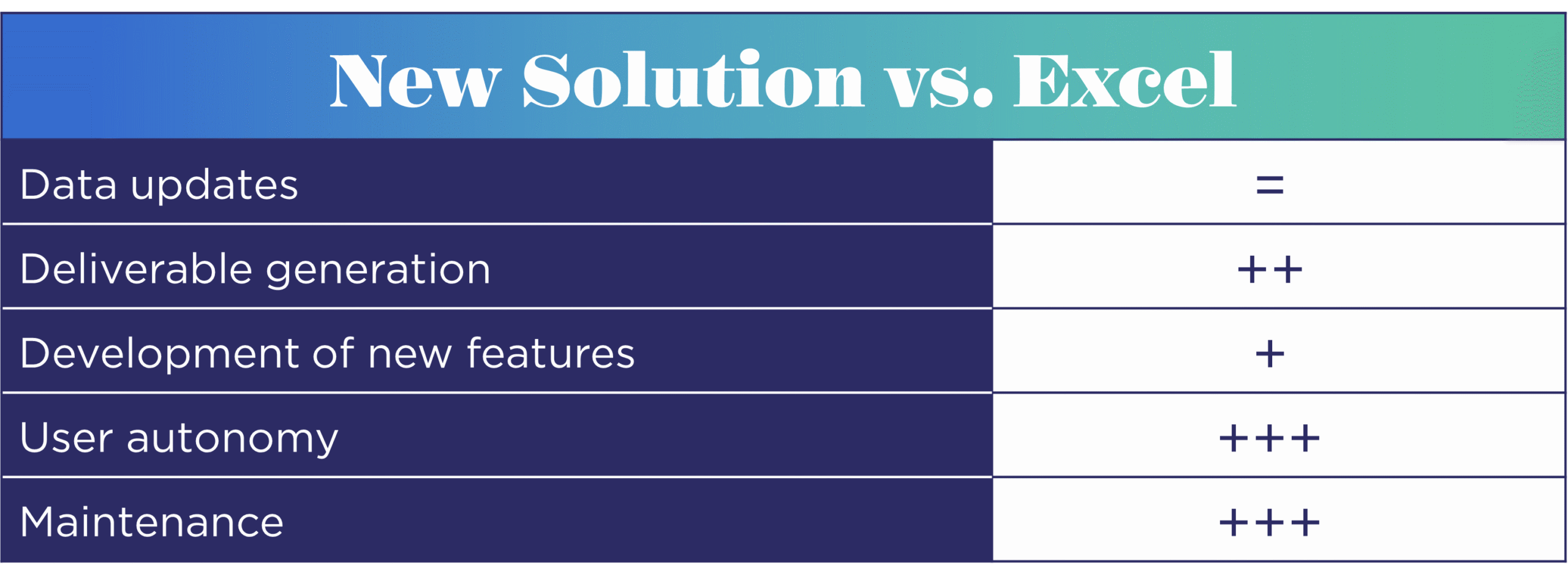
Comparison between the 2 solutions
Conclusion
The digital transformation of the client’s milestone tracking process, which was initially done using complex Excel documents, has had many benefits.
The deployment of the new Power Apps tool has allowed teams to focus on high-value tasks, reduce tool maintenance time, and simplify data management. Overall, a significant gain in productivity was observed and the engagement was thus reduced by one FTE.
The new reporting tool has made it possible per week to save:
- For 20 users: between 5 and 15 minutes,
- For the client in charge of reporting: between 2 and 3 hours,
- For the MIGSO-PCUBED team: between 2 and 8 hours depending on the actions carried out.
However, it is important to note that the value of a digital transformation must be assessed and consider the specificities of each industry. A risk-benefit analysis must be conducted to ensure that the expected results justify the investment and change management efforts.
To go further, being open to use AI can also offer new perspectives to further optimize the milestone tracking process. Predictive analytics and technical documentation support, enabled by AI, would allow for even more proactive project management.
Results
This digital transformation has generated many significant results, testifying to a significant improvement in the efficiency and productivity of processes and deliverables.
Key figures
- Reduced workload for tool maintenance by 10 percent points (from 10% to 0%)
- Saved 2 to 3 hours per week on report creation
- Saved 5 to 15 minutes per week for all users